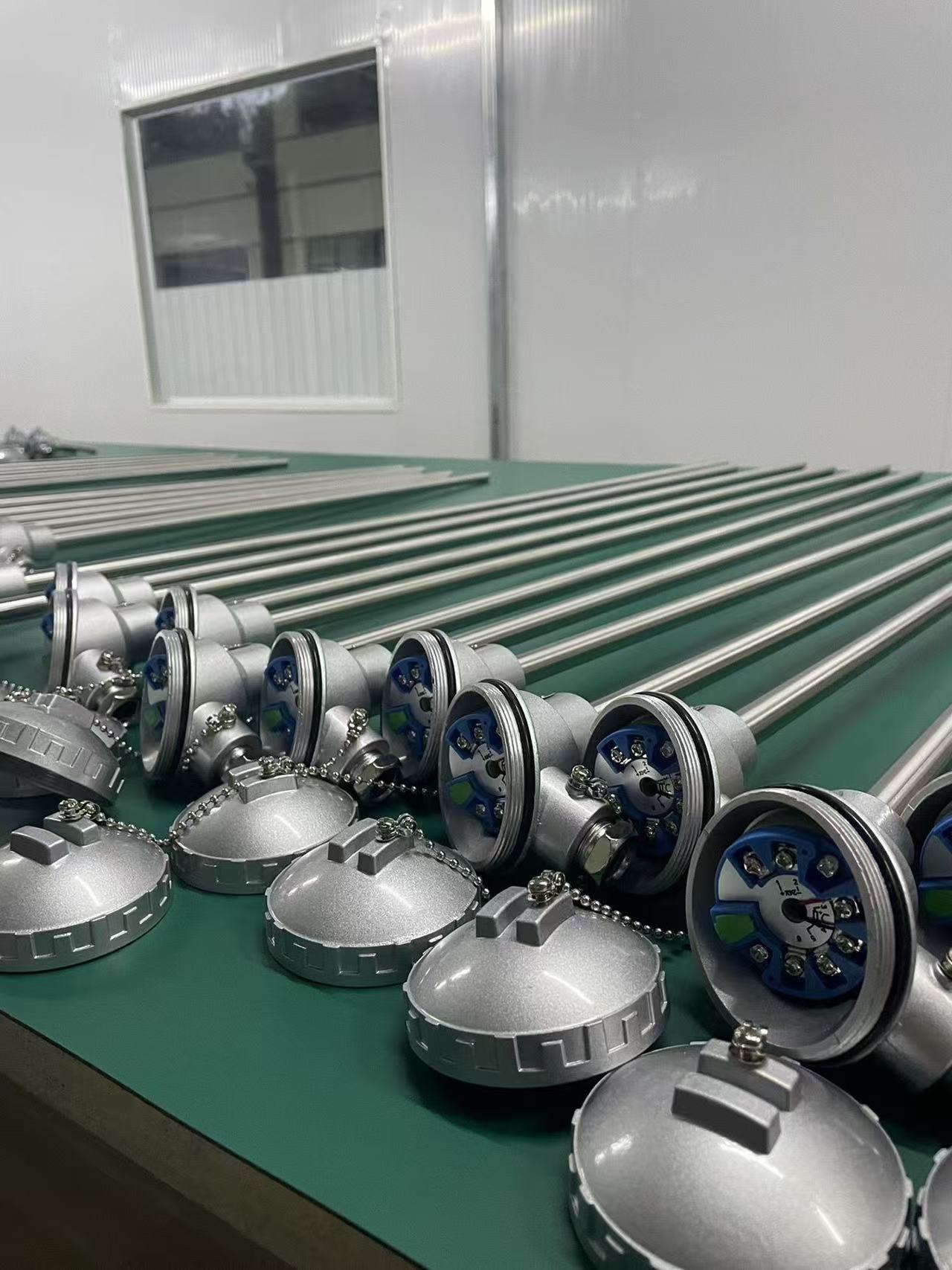
K-type vs PT100 — which one do you need?
We get this question every week. The short answer: if your process runs above 600°C, or you need a fast response, go thermocouple. If you need ±0.5°C accuracy below 600°C, go PT100 RTD. We build both.
Thermocouples generate their own voltage from two dissimilar metals welded at the tip — no external power needed. PT100 sensors measure the resistance of a platinum element and need a loop-powered transmitter. In our Yangzhou factory we calibrate every sensor against a reference bath before it ships.
Typical Specifications
| Sensor type | K-type / J-type / PT100 (3-wire) |
| Temperature range | K: -200 to 1200°C · PT100: -200 to 600°C |
| Probe diameter | Ø1 mm to Ø8 mm (MI cable) / flanged assemblies up to Ø22 mm |
| Probe length | 50 mm to 2000 mm, custom on request |
| Sheath material | 304 SS / 316L SS / Inconel 600 / Incoloy 800 |
| Accuracy | K: ±1.5°C or ±0.4% · PT100: Class A ±0.15°C |
| Connection head | Aluminum terminal head / stainless / mineral-insulated with lead wire |
| Process connection | NPT thread / metric thread / flange / weld pad |
What we offer
- Mineral-insulated (MI) thermocouples — flexible, bendable, up to 600°C continuous
- Assembled thermocouples with aluminum head, terminal block and compression fitting
- PT100 RTD probes, 3-wire or 4-wire, Class A or 1/3 DIN
- With or without built-in transmitter (4–20 mA output)
- Bayonet, spring-loaded or welded tip for die and mold temperature measurement
Common Applications
Industrial furnaces & boilers
Ovens and duct heaters
Reaction vessels & tanks
Injection molds & hot runners
Platens and hot presses
Pipe trace heating control
Need thermocouples matched to your heater?
Send us the temperature range, probe length, thread size and cable length. We'll build the sensors and ship them alongside your heaters — same drawing, same shipment.
Send Your Specs